In many call centers, compliance is treated as a checklist.
Say the right line.
Follow the script.
Tick the box.
On paper, that makes sense. It’s clear, measurable, and easy to audit.
But in real conversations, it rarely works that way.
The Reality of Live Calls
Customers don’t pause so an agent can deliver a disclaimer perfectly.
They interrupt.
They ask questions halfway through.
They go off-topic.
They’re frustrated, distracted, or in a hurry.
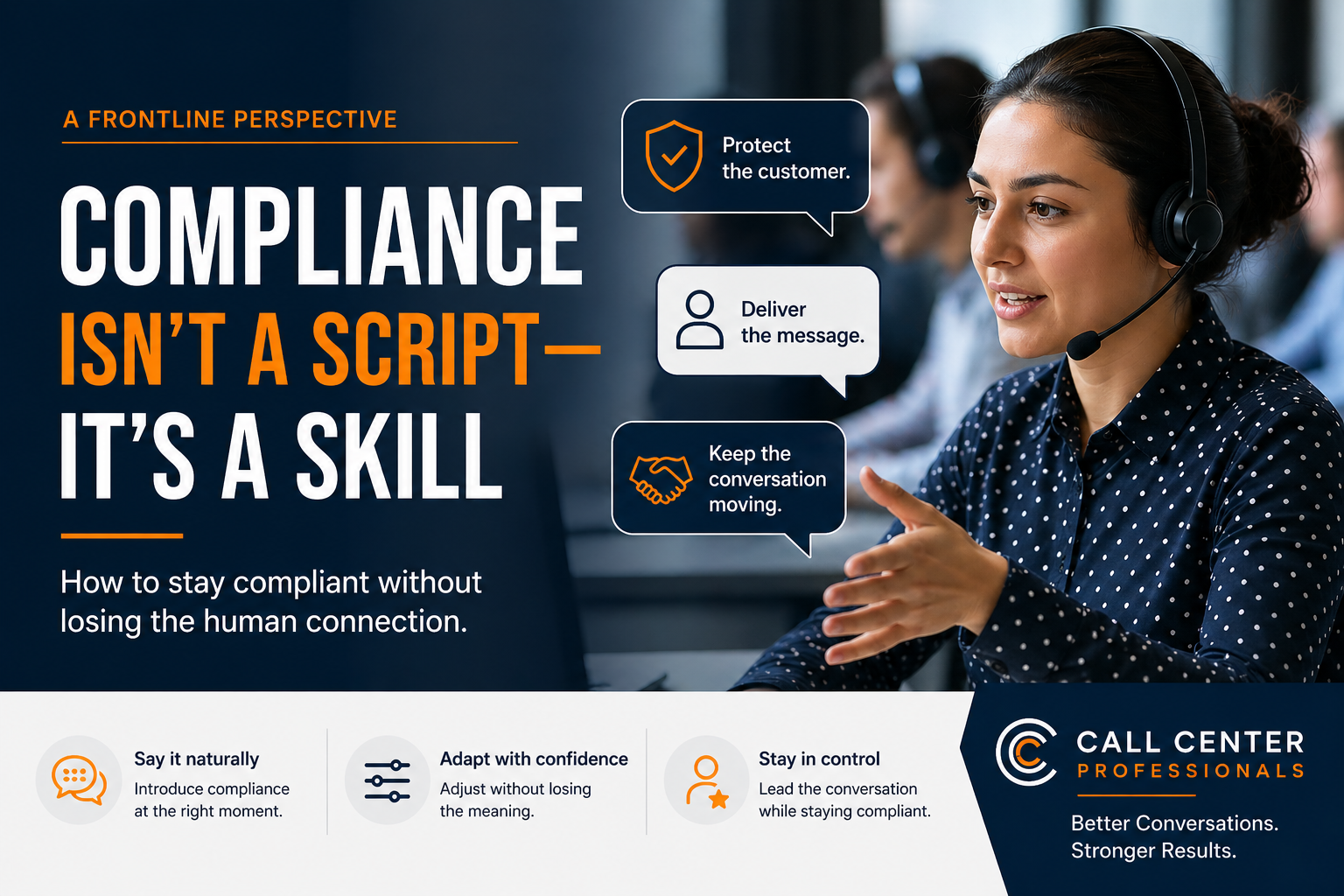
And in those moments, compliance stops being a script—and starts becoming a skill.
Because the challenge isn’t just what to say.
It’s:
- When to say it
- How to say it
- How to keep control of the conversation while saying it
Where Scripted Compliance Breaks Down
When compliance is treated as a rigid script, a few things tend to happen:
- It disrupts the natural flow of the conversation
- It feels robotic to the customer
- Agents rush through it just to “get it done”
- Or worse—it gets skipped altogether
From a QA perspective, it might still get ticked off.
But from a customer experience perspective, it often creates friction.
What Good Compliance Actually Looks Like
Strong agents approach compliance differently.
They don’t just recite it—they integrate it.
That means:
- Introducing key messages at the right moment
- Adapting wording without losing meaning
- Maintaining a natural tone
- Keeping the conversation moving
When it’s done well, the customer often doesn’t even notice it as “compliance.”
They just experience a smooth, professional interaction.
The Balance: Human + Compliant
There’s often a perceived trade-off:
👉 Be compliant
or
👉 Sound natural
In reality, the best agents do both.
They understand the intent behind the requirement—not just the wording.
So instead of focusing on:
“Did I say this exactly right?”
They focus on:
“Did I clearly and correctly communicate what matters?”
Why This Matters for QA and Training
This is where many QA frameworks fall short.
If scoring focuses only on:
- Whether something was said
- Rather than how it was delivered
You end up reinforcing behaviour that:
- Meets the requirement
- But harms the experience
The same applies to training.
Teaching scripts alone isn’t enough.
Agents need:
- Context
- Flexibility
- Confidence in delivery
A Frontline Perspective
From a frontline perspective, the pressure is real.
Agents are balancing:
- Compliance requirements
- Call handling time
- Customer expectations
- System limitations
If compliance isn’t designed to fit naturally into the conversation, it becomes something agents work around—not with.
And that’s where risk increases.
Making Compliance Work in Practice
To make compliance more effective, a shift is needed:
- Focus on intent, not just wording
- Train for real conversations, not ideal ones
- Build flexibility into scripts
- Align QA scoring with real-world delivery
Because ultimately:
👉 Compliance that works in theory isn’t enough
👉 It has to work in conversation
Final Thought
Compliance shouldn’t sit outside the interaction as a separate task.
It should be part of the conversation—natural, clear, and effective.
Because when compliance is done well:
- The customer feels understood
- The agent stays in control
- And the business is still protected
If you’re looking to better align compliance, QA, and real customer interactions, feel free to get in touch.