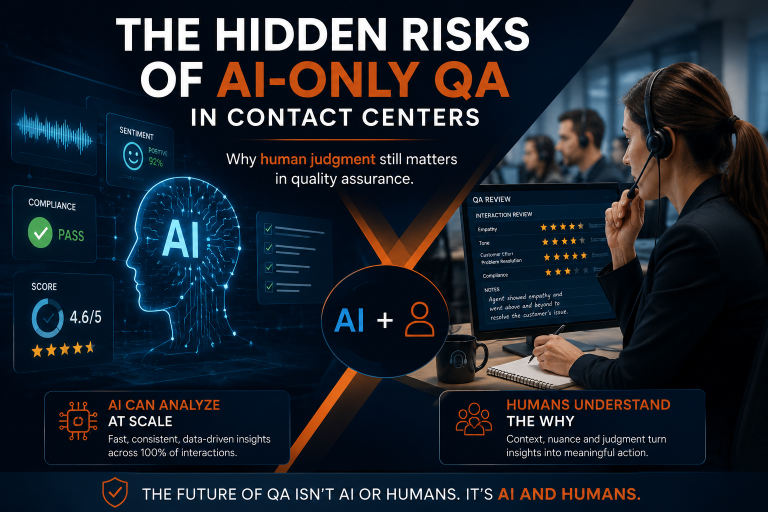
In most contact centres, Quality Assurance (QA) is an internal function.
Team leaders review calls. Scorecards are completed. Coaching follows. Performance improves.
Operationally, it works.
But when you move into high-trust environments—utilities, government, regulated industries—internal QA on its own starts to show its limits.
Because at that level, QA isn’t just about improving performance.
It’s about proving it.
The Shift: From Performance to Proof
Internal QA is designed to answer one question:
“How are we performing?”
But clients in high-trust sectors are asking a different question:
“How do we know we can trust your performance?”
That distinction matters.
When QA is entirely internal:
- Scoring frameworks can vary across campaigns
- Results can feel subjective
- Reporting lacks independent validation
Even when the work is strong, the perception can be:
“They’re marking their own homework.”
And in high-stakes environments, perception carries weight.
Where Internal QA Starts to Fall Short
1. Lack of Independent Validation
Internal QA reflects internal standards.
That’s valuable—but it doesn’t provide external assurance.
For clients managing compliance risk, that gap matters.
2. Inconsistency Across Campaigns
Different campaigns often develop:
- Different scoring interpretations
- Different coaching styles
- Different quality thresholds
Over time, this creates fragmentation.
And fragmentation erodes confidence.
3. Limited Client Visibility
Many QA programs are:
- Summarised
- Filtered
- Or translated into high-level reporting
Clients rarely see:
- Raw performance trends
- Behavioural insights
- Real interaction quality
That lack of transparency can become a barrier to trust.
4. Bias—Even When Unintentional
Internal QA is never deliberately biased.
But it is inherently influenced by:
- Internal relationships
- Performance expectations
- Operational pressures
That doesn’t make it wrong.
It just means it isn’t fully independent.
What Changes with Independent QA
Introducing a third-party QA layer doesn’t replace internal QA.
It strengthens it.
It shifts the conversation from:
“Here’s how we think we’re performing”
To:
“Here’s independently validated performance you can rely on”
The impact is immediate:
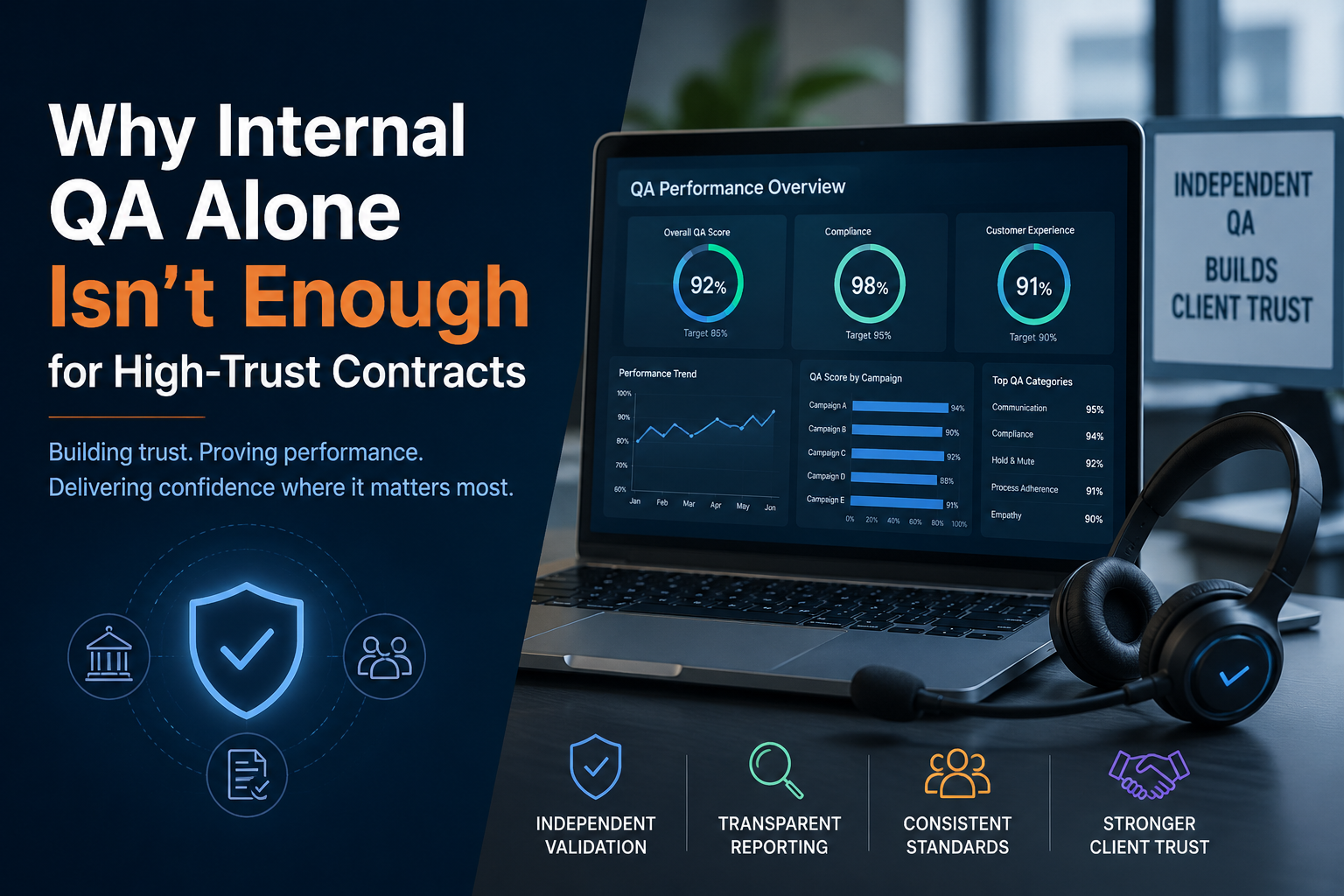
✔ Consistency Across Campaigns
A single framework applied across all interactions
→ Clear, comparable performance standards
✔ Client-Facing Transparency
Dashboards and reporting that can be shared externally
→ Builds confidence and credibility
✔ Real-World Testing
Mystery shopper-style interactions
→ Capture true customer experience, not staged behaviour
✔ Stronger Positioning for High-Trust Contracts
Independent QA becomes part of your value proposition
→ Not just operational hygiene
The Commercial Opportunity Most Teams Miss
There’s another layer to this that often gets overlooked.
Independent QA isn’t just:
- A quality tool
- A compliance safeguard
It can also be:
A client-facing, revenue-generating service
When structured correctly:
- QA interactions can be billed
- Reporting can be packaged
- Insights can be positioned as premium value
This changes QA from:
A cost centre
To:
A commercial offering that supports growth
Why This Matters Now
As outsourcing providers move further into:
- Utilities
- Government
- Regulated industries
The expectations shift.
It’s no longer enough to say:
“We have QA in place”
You need to demonstrate:
- Consistency
- Transparency
- Independence
Because in these environments:
Trust isn’t assumed—it’s verified.
Bringing It Together
Internal QA will always be essential.
But on its own, it was never designed to:
- Build external trust
- Support high-stakes contracts
- Act as a commercial differentiator
That’s where independent QA comes in.
Not as a replacement.
But as the layer that makes everything else credible, scalable, and sellable.
Final Thought
If you’re targeting—or already operating within—high-trust sectors, it’s worth asking:
Is your QA just improving performance… or is it proving it?