Separating Genuine Intelligence from Marketing Hype in Customer Service
If you’ve spent any time in the contact centre industry over the last two years, you’ve probably noticed that suddenly everything has become “AI.”
AI-powered customer service.
AI-powered voice agents.
AI-powered customer engagement.
AI-powered call routing.
AI-powered chatbots.
The problem is that many of these solutions aren’t actually artificial intelligence at all.
They’re technologies that have existed for years, sometimes decades, repackaged with an AI label because that’s what the market wants to hear.
As organisations rush to modernise their customer service operations, it’s becoming increasingly important to understand the difference between true AI and traditional automation.
Because they’re not the same thing.
The Great AI Rebrand
Let’s start with a simple example.
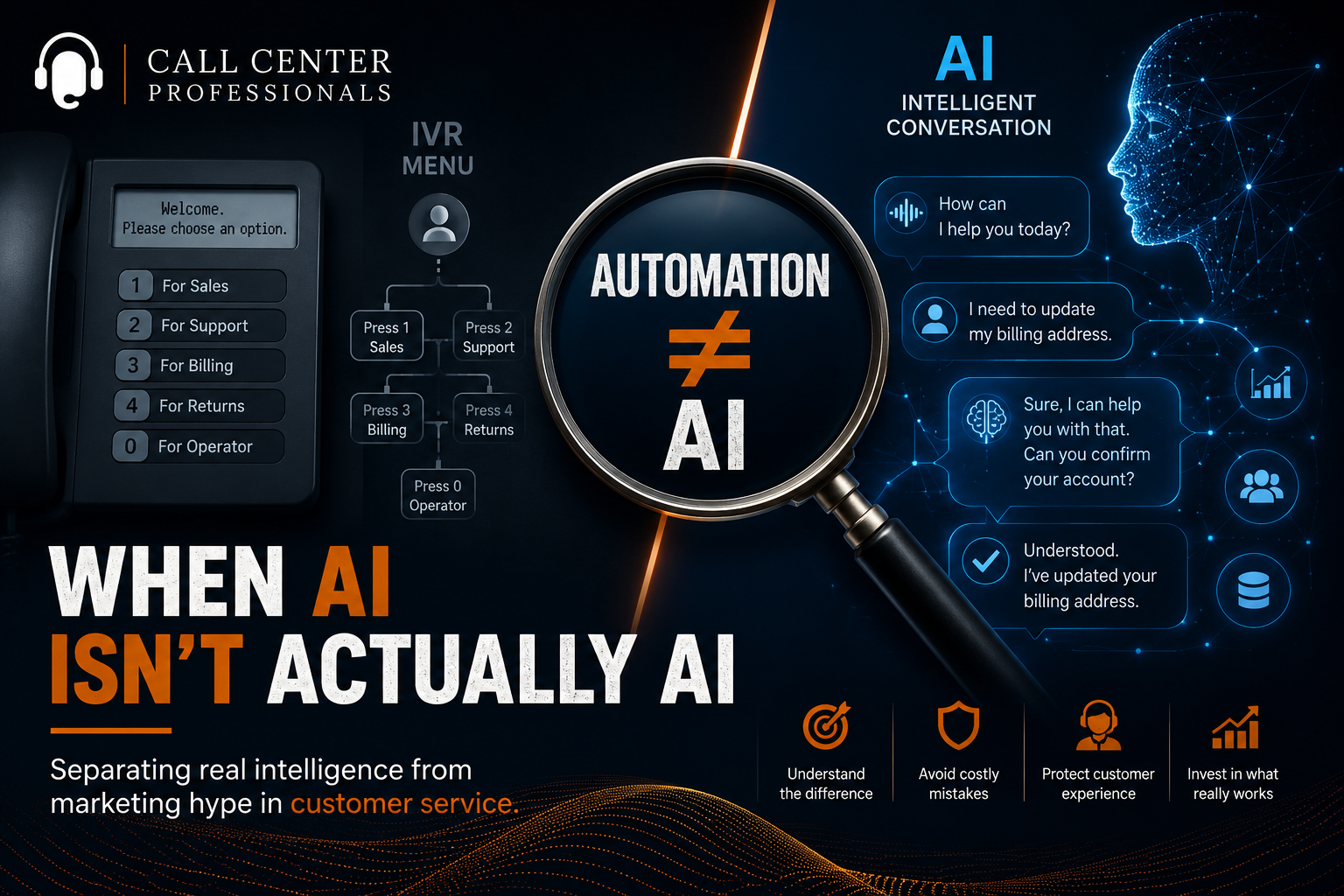
Many businesses are being sold “AI voice solutions” that are little more than modern IVR systems.
If a customer calls and hears:
“Press 1 for sales, press 2 for support.”
Most people immediately recognise this as an IVR.
But what if the system says:
“Please tell me what you’re calling about today.”
The customer responds:
“Billing enquiry.”
The system recognises the phrase and routes the call.
Suddenly the vendor starts calling it an AI-powered voice assistant.
Has the experience changed?
Slightly.
Has the technology fundamentally changed?
Not necessarily.
Voice recognition has existed in contact centres for many years. Converting speech into text and matching it against predefined options isn’t the same thing as reasoning, learning or making intelligent decisions.
Yet many organisations are paying AI premiums for technology that is essentially an updated IVR.
Automation Is Not Intelligence
Automation is incredibly valuable.
In fact, some of the best efficiency improvements I’ve seen in contact centres have come from automation.
Automatically sending emails.
Automatically updating CRM records.
Automatically routing interactions.
Automatically generating reports.
These are all worthwhile improvements.
But automation follows rules.
Artificial intelligence makes decisions based on context.
That’s an important distinction.
If a system can only follow a predefined path, it isn’t thinking.
It’s executing instructions.
And that’s perfectly fine.
The problem begins when organisations don’t understand the difference.
The Risk of Buying Buzzwords
Many decision makers are under pressure to demonstrate AI adoption.
Board members are asking about it.
Clients are asking about it.
Competitors are talking about it.
As a result, some organisations are purchasing “AI solutions” without fully understanding what they’re buying.
This can create several problems:
Unrealistic Expectations
A client expects intelligent conversation.
What they receive is a sophisticated decision tree.
The gap between expectation and reality creates frustration.
Poor Customer Experiences
Customers quickly recognise when they’re trapped in an automated process that can’t adapt to their situation.
The result is often increased effort and lower satisfaction.
Paying More for Existing Technology
Some vendors have simply added an AI label to existing products and increased the price.
The functionality hasn’t changed.
The marketing has.
What Real AI Looks Like
True AI in customer service can be incredibly powerful.
Examples include:
- Real-time agent assistance during conversations
- Sentiment analysis and emotional trend detection
- Automatic summarisation of interactions
- Knowledge retrieval based on conversation context
- Intelligent coaching recommendations
- Generative responses tailored to individual situations
- Pattern recognition across thousands of interactions
These tools don’t simply follow a script.
They analyse information, identify patterns and adapt outputs based on context.
That is fundamentally different from traditional automation.
The Questions Every Buyer Should Ask
Before investing in any AI solution, ask a few simple questions:
What decisions is the system making independently?
If the answer is “none,” it may simply be automation.
Can the system learn and improve over time?
If not, it may not be AI.
What happens when the customer asks something unexpected?
This quickly reveals the difference between intelligence and a decision tree.
Would this solution have existed five years ago under a different name?
Sometimes the answer is surprisingly revealing.
Focus on Outcomes, Not Labels
The reality is that automation isn’t bad.
IVRs aren’t bad.
Workflow engines aren’t bad.
Voice recognition isn’t bad.
They all have legitimate uses.
The problem occurs when organisations buy technology because of what it’s called rather than what it actually does.
The best contact centre leaders don’t ask:
“Is it AI?”
They ask:
“What problem does it solve?”
Because at the end of the day, customers don’t care whether a solution uses artificial intelligence, automation, machine learning or a combination of all three.
They care whether their issue gets resolved quickly, accurately and with minimal effort.
And that’s a goal that requires more than clever marketing.
It requires understanding the difference between technology that sounds intelligent and technology that genuinely is.
About Call Center Professionals
Call Center Professionals provides independent QA audits, mystery shopper programs, customer experience insights and performance reporting for contact centres across New Zealand and Australia.
Because quality should be measured by outcomes, not buzzwords.